

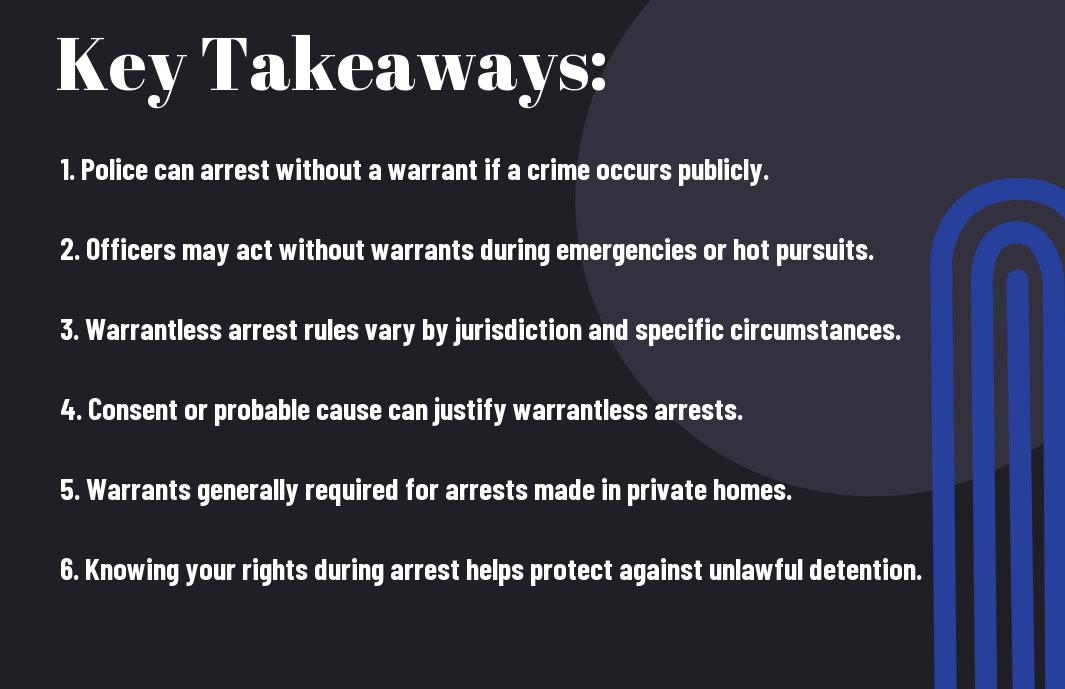
Just because you haven’t committed a crime doesn’t mean you can’t find yourself in a situation where law enforcement may detain you without a warrant. Understanding when and how this can occur is important for knowing your rights and responsibilities. This post will explore the circumstances under which you can be arrested without a warrant, the legal exceptions that apply, and what you should do if you ever face such a scenario. Being informed can empower you to protect your rights effectively.

Understanding Arrest Warrants
The concept of an arrest warrant is vital in the legal system. It serves as a formal authorization, issued by a judge or magistrate, permitting law enforcement to detain an individual suspected of committing a crime. This legal document ensures that individual rights are protected by requiring sufficient evidence before an arrest can occur.
Definition of an Arrest Warrant
Before venturing into the types of arrest warrants, it’s vital to grasp their definition. An arrest warrant is a legal document requesting the arrest of a specific individual. It outlines the charges against you, ensuring that law enforcement acts within the constraints of the law.
Types of Arrest Warrants
Warrants can vary based on the specific circumstances of your case. The main types of arrest warrants include:
- Bench Warrants: Issued when a person fails to appear in court.
- Regular Arrest Warrants: Issued when there is probable cause to suspect someone of a crime.
- Search Warrants: Allow law enforcement to search premises related to a crime.
- Federal Warrants: Issued for violations of federal law.
- Probation Violation Warrants: For individuals who violate the terms of their probation.
Any of these warrants can lead to your arrest depending on the situation.
| Type of Warrant | Description |
|---|---|
| Bench Warrant | For failure to appear in court. |
| Regular Arrest Warrant | Based on probable cause of a crime. |
| Search Warrant | To search specific places related to a case. |
| Federal Warrant | For violations of federal laws. |
| Probation Violation Warrant | Issued for breaching probation terms. |
At this point, you should have a clearer understanding of the types of arrest warrants that can be issued against you. Different warrants serve different legal purposes, and knowing about them can help you navigate any potential legal challenges. Here’s a quick summary:
- Bench Warrants arise from court attendance issues.
- Regular Arrest Warrants require probable cause.
- Search Warrants are focused on specific evidence locations.
- Federal Warrants link to federal crimes.
- Probation Violation Warrants address breaches in probation.
Any of these can lead to potential legal consequences you need to be aware of.
Circumstances for Arrest Without a Warrant
Assuming you find yourself in a situation involving law enforcement, it is important to understand the conditions under which you can be arrested without a warrant. Certain scenarios allow police officers to take action without prior judicial approval, often based on the immediate need for intervention or concern for individual or community welfare. Familiarizing yourself with these circumstances can empower you to navigate encounters with law enforcement more effectively.
Exigent Circumstances
Before police can arrest you without a warrant, they must demonstrate exigent circumstances. This refers to situations where law enforcement believes immediate action is necessary to prevent harm, destruction of evidence, or a suspect escaping. For example, if the police are chasing a suspect who enters a home, they may pursue without a warrant to ensure public safety.
Public Safety Concerns
With public safety being a primary concern, law enforcement officials may arrest you without a warrant if your actions pose an immediate threat to yourself or others. These arrests are typically justified when there are reasonable grounds to believe that harm could occur if the individual is not detained. Examples can include situations involving violence, domestic disputes, or highly volatile conditions.
Due to the inherent unpredictability of certain situations, law enforcement has the authority to act swiftly when they perceive a potential danger. This could involve intervening in a domestic violence case where an individual is in immediate peril or addressing threats during large public gatherings. Your safety, and that of others, often guides these prompt decisions, prioritizing the need to quickly neutralize a hazardous situation over obtaining a warrant.
Legal Standards Governing Warrantless Arrests
To understand the legality of warrantless arrests, it is important to know the legal standards that govern them. Law enforcement officers can make an arrest without a warrant when specific criteria are met. These criteria primarily revolve around the concepts of probable cause and reasonable suspicion, which guide officers in determining whether they have adequate justification for an arrest. If those criteria are satisfied, an arrest can be deemed lawful without the need for a warrant.
Probable Cause
After evaluating the circumstances, law enforcement must establish probable cause to make a warrantless arrest. This means they have enough evidence or reasonable grounds to believe that a crime has been committed and that the individual in question is responsible. The bar for probable cause is higher than for reasonable suspicion, requiring more concrete facts or reliable information that support the belief that an offense has occurred.
Reasonable Suspicion
Suspicion that an individual is involved in criminal activity does not always warrant an arrest but can lead to a stop and investigative questioning. Law enforcement needs reasonable suspicion, which is a lower standard than probable cause. It often relies on an officer’s training and experience combined with specific facts to justify an encounter.
And while reasonable suspicion allows officers to engage with potential suspects, it must be based on observable behaviors or credible information that suggest criminal involvement. This lower threshold enables officers to act quickly in potentially dangerous situations, ensuring public safety while still respecting individuals’ rights. However, it is important to note that reasonable suspicion alone does not authorize an arrest; it merely allows for further investigation or questioning.
Consequences of Warrantless Arrests
Once again, warrantless arrests can lead to significant consequences for both you and law enforcement. If you are arrested without a warrant, any evidence collected during that arrest may be deemed inadmissible in court, potentially jeopardizing a prosecution’s case. Furthermore, law enforcement officers may face civil lawsuits for violating your rights, resulting in monetary compensation awarded to you. Being aware of your rights in such situations can empower you to navigate the complexities of the legal process effectively.
Legal Ramifications
Below are some legal ramifications that can arise from warrantless arrests. In many cases, you may have grounds to challenge the legality of the arrest, leading to your immediate release. Courts typically scrutinize warrantless arrests under the Fourth Amendment, which protects against unreasonable searches and seizures. If the court finds that the arrest was unlawful, it may dismiss charges against you and suppress any evidence obtained during that arrest, significantly affecting the prosecution’s case.
Defenses Against Warrantless Arrests
Warrantless arrests can be contested legally if you believe your rights were violated. Indeed, common defenses include asserting that law enforcement did not have probable cause or that the arrest lacked exigent circumstances justifying immediate action. You may also argue that the police did not follow proper procedures during the arrest, such as failing to identify themselves or not informing you of the charges. Building a strong defense may involve gathering evidence and witness statements that support your claims, making legal counsel imperative in these situations.
Case Studies and Precedents
Your understanding of warrantless arrests can be enhanced through examining key case studies and legal precedents. Consider the following examples:
- Case 1: *Terry v. Ohio* (1968): Upheld stop-and-frisk procedures based on reasonable suspicion.
- Case 2: *Payton v. New York* (1980): Established the need for a warrant to enter a person’s home.
- Case 3: *Arizona v. Gant* (2009): Limited police authority to search vehicles without a warrant.
- Case 4: *United States v. Watson* (1976): Allowed warrantless arrests in public if based on probable cause.
Landmark Cases
Above, you explored some crucial case studies. Landmark cases like *Terry v. Ohio* continue to influence how law enforcement operates without a warrant, establishing parameters for when police can act based on suspicion rather than concrete evidence.
Recent Developments in Case Law
At the forefront of evolving legal standards are recent developments that significantly impact warrantless arrests. Courts are increasingly scrutinizing police practices to balance individual rights against effective law enforcement.
Indeed, recent rulings highlight a judicial trend toward protecting citizens’ Fourth Amendment rights. For example, the *Caniglia v. Strom* decision (2021) emphasized that community caretaking exceptions do not justify warrantless home entries. Such cases demonstrate a growing concern over government overreach, compelling law enforcement agencies to adapt their strategies while respecting constitutional protections.
Summing up
Upon reflecting, you should understand that it is indeed possible to be arrested without a warrant under specific circumstances, such as when a crime is committed in your presence or if law enforcement has probable cause to believe that you have committed a crime. Knowing your rights and recognizing the situations that allow for warrantless arrests can empower you in encounters with law enforcement. Always consider seeking legal counsel if you find yourself in such a situation to ensure that your rights are protected.