

Most people might not realize that there are specific legal parameters that determine when a search and seizure can be deemed illegal. Understanding these parameters is imperative for protecting your rights and ensuring law enforcement adheres to legal protocols. This blog post will explore the circumstances under which searches and seizures may violate your constitutional rights, outlining key concepts such as probable cause, consent, and the exclusionary rule. Let’s probe into what constitutes an illegal search and seizure and how you can safeguard yourself in various situations.

Legal Framework of Search and Seizure
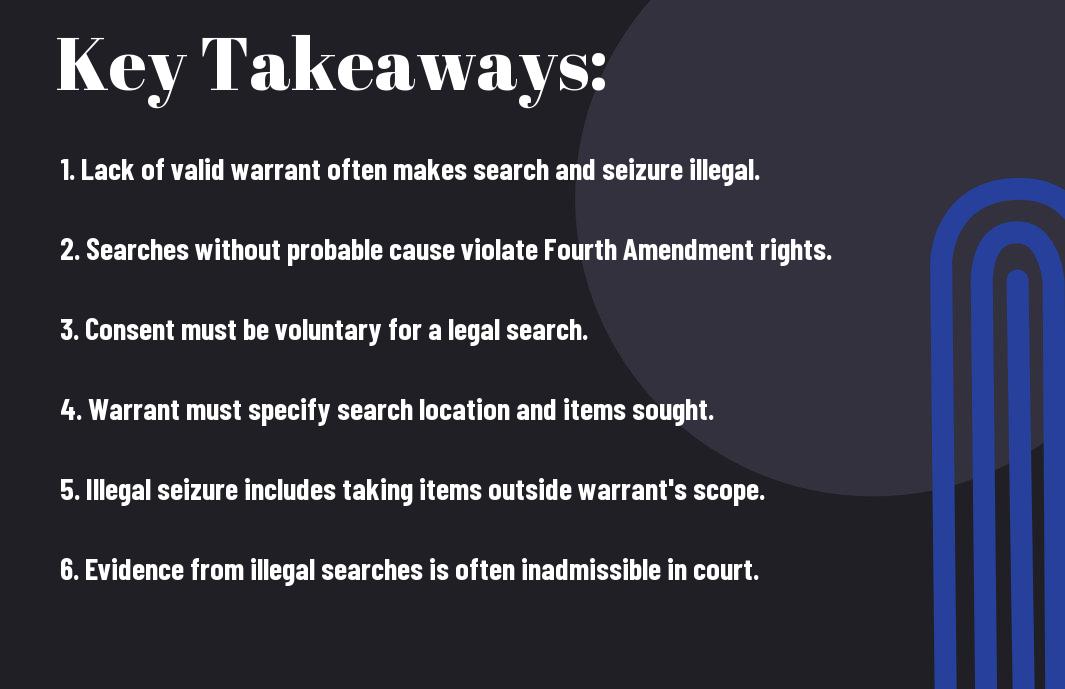
To understand when a search and seizure may be deemed illegal, you need to familiarize yourself with the legal frameworks that govern them. The U.S. Constitution, along with various federal and state laws, outlines the circumstances under which law enforcement can conduct searches and seizures. These regulations are designed to protect your privacy rights while allowing the police to investigate criminal activities under specific conditions.
Fourth Amendment Overview
About the Fourth Amendment, it serves as a vital safeguard of your rights by protecting you against unreasonable searches and seizures. This constitutional provision requires that any search or seizure be based on probable cause, ensuring that law enforcement officials cannot invade your privacy without substantial justification or legal basis.
Warrant Requirements
On the topic of warrant requirements, the Fourth Amendment mandates that law enforcement obtain a warrant from a judge or magistrate before conducting most searches. This warrant must be grounded in probable cause and specify the location to be searched as well as the items to be seized, providing a check on police power.
To obtain a warrant, law enforcement must present sufficient evidence to a judge that suggests a crime has occurred or that evidence of a crime is located at the specified location. This helps ensure that any invasion of your privacy is not arbitrary or capricious. If law enforcement skips this step and conducts a search without a warrant, it may be challenged in court as illegal, potentially causing any evidence obtained during that search to be inadmissible in legal proceedings against you.
Exceptions to Warrant Requirements
Clearly, understanding the exceptions to warrant requirements is crucial for grasping when a search and seizure may be deemed legal. Certain circumstances allow law enforcement officers to conduct searches without a warrant, prioritizing public safety and immediate action over the standard legal procedures. Familiarizing yourself with these exceptions can help you better understand your rights in potentially compromising situations.
Consent Searches
With consent searches, you may unwittingly allow law enforcement to search your property or belongings. If you give an officer permission to conduct a search, they do not need a warrant. It is vital to know that you have the right to refuse consent, and that any search conducted without your permission may still be subject to legal scrutiny.
Exigent Circumstances
By exigent circumstances, law enforcement can conduct a search or seizure without a warrant if they believe that waiting for one could lead to the destruction of evidence, imminent harm to individuals, or a suspect fleeing. These situations require quick, decisive actions to protect life, property, or preserve vital evidence.
For instance, if you are in a situation where someone has reported a domestic disturbance, the police may enter your home without a warrant if they believe someone could be in danger. This rapid response is intended to prevent greater harm, allowing officers to take action that prioritizes safety over procedural norms. It’s important to know that these situations are taken very seriously and are evaluated on a case-by-case basis, highlighting the balance law enforcement must strike between protecting individual rights and ensuring public safety.
Reasonableness Standard
Your understanding of the reasonableness standard is vital when assessing whether a search and seizure is illegal. This standard evaluates the actions of law enforcement against the Fourth Amendment, which protects you from unreasonable searches. The key question is whether the government’s intrusion was justified by a legitimate state interest, balancing individual rights and public safety.
Reasonable Expectation of Privacy
On determining the legality of a search, it is important to consider your reasonable expectation of privacy. This expectation varies depending on the context, such as whether you are in your home, a vehicle, or a public place. Courts assess this expectation by looking at whether society would view the intrusion as an infringement on your privacy rights.
Balancing Test
Among the factors courts weigh in the balancing test are the nature of the privacy being invaded and the severity of the law enforcement interest at stake. This test seeks to strike a fair balance between your rights and the need for law enforcement to maintain public order and safety.
With this test, the courts analyze the specific circumstances surrounding a search, including the scope of the intrusion and the justification provided by authorities. If the search appears overly intrusive compared to the interests being pursued, it may be deemed unreasonable. Essentially, this approach serves to ensure that your privacy is adequately protected while allowing law enforcement to perform their duties effectively.
Illegality of Search and Seizure
After a search and seizure is deemed illegal, the evidence obtained during that process cannot be used in court. This illegality typically arises when law enforcement oversteps their boundaries, such as executing a search without a warrant, probable cause, or violating your rights. Understanding when a search is illegal is crucial for protecting yourself and ensuring that any evidence against you is legitimate and permissible in legal proceedings.
Fruit of the Poisonous Tree Doctrine
About the Fruit of the Poisonous Tree Doctrine, this legal principle asserts that any evidence derived from an illegal search or seizure is also inadmissible in court. In essence, if the initial evidence was obtained unlawfully, subsequent evidence that stems from it is tainted and cannot be used to substantiate a case against you. This doctrine reinforces the importance of adhering to constitutional rights during investigations.
Exclusionary Rule
Tree, the Exclusionary Rule prevents illegally obtained evidence from being used in court. This rule serves as a safeguard for your constitutional rights, ensuring that law enforcement follows proper protocols when conducting searches and seizures. If the evidence against you is gathered without adhering to legal standards, it should be excluded from trial.
Fruit of the Exclusionary Rule is significant because it not only protects your rights but also serves as a deterrent against unlawful police action. When you understand this rule, you can leverage it to challenge the legitimacy of the evidence presented against you. Additionally, this rule underscores the principle that maintaining the integrity of the legal process is crucial for justice to prevail.
Implications of Illegal Search and Seizure
Unlike legal searches that follow strict guidelines, an illegal search and seizure can lead to various negative consequences for both individuals and law enforcement. If evidence obtained through an unlawful search is introduced in court, it may be deemed inadmissible, which can weaken the prosecution’s case. Additionally, illegal searches can erode public trust in law enforcement and have long-lasting impacts on community relations. Understanding these implications can prepare you for any encounters with law enforcement.
Criminal Proceedings
Among the significant outcomes of an illegal search and seizure is its effect on criminal proceedings. If the court finds that your rights were violated during a search, any evidence collected may be excluded from consideration, potentially leading to dismissal of charges against you or reduced penalties. This evidentiary rule serves as a safeguard against government overreach, ensuring that you are treated fairly within the justice system.
Civil Suits Against Law Enforcement
The consequences of an illegal search may also extend beyond criminal court, allowing you the possibility to file civil suits against law enforcement officers. Should you believe your rights have been infringed upon, you may seek compensation for damages resulting from the unlawful search. Civilians often pursue claims such as emotional distress or violation of their constitutional rights, serving both as a personal remedy and as a means to hold law enforcement accountable for their actions.
At times, pursuing a civil suit against law enforcement can lead to significant outcomes, including financial compensation or policy changes within the agency. You might have grounds to file a lawsuit based on various theories, such as a violation of your Fourth Amendment rights or false imprisonment. Understanding the legal framework is vital for successfully navigating this process, as you’ll want to ensure that your case demonstrates clear evidence of wrongdoing by law enforcement officers. Civil suits not only seek justice for you but can also contribute to broader systemic changes in law enforcement practices.
Recent Case Law and Trends
All citizens should stay informed about evolving legal interpretations regarding search and seizure. Recent case law has showcased the balance courts strive to maintain between individual rights and public safety. Understanding these trends can help you better grasp your rights and the protections offered under the Fourth Amendment.
Notable Supreme Court Cases
Below are a few landmark Supreme Court cases that have shaped the understanding of search and seizure laws. Decisions like Mapp v. Ohio and Katz v. United States highlight the ongoing evolution of how the courts view privacy and property in different contexts. These cases are integral to your understanding of your rights during encounters with law enforcement.
Current Legal Discussions
To stay aware of the ongoing debates surrounding search and seizure issues, it’s crucial to follow current legal discussions. Legal scholars are examining how technology impacts privacy rights, debating topics such as digital searches and surveillance practices. You can gain insight into how these conversations may influence future rulings by engaging with legal analyses and staying updated on new developments.
Supreme Court rulings reflect an ongoing dialogue regarding the balance between law enforcement needs and individual rights. Issues like warrantless searches of electronic devices and surveillance technology are becoming increasingly significant in current legal discourse. Engaging with these topics will enhance your understanding of how evolving technology may reshape your privacy rights, and it can arm you with knowledge on how to respond should you encounter law enforcement. You can actively participate in this conversation through legal forums, articles, and community discussions.
Final Words
As a reminder, a search and seizure is deemed illegal if conducted without a warrant, probable cause, or when it violates your reasonable expectation of privacy. Understanding your rights plays an imperative role in protecting yourself against unlawful searches. If law enforcement oversteps their boundaries during a search, it can lead to evidence being deemed inadmissible in court. Staying informed about your rights helps you navigate the complexities of legal interactions and ensures that you are adequately prepared to assert your protections under the law.