
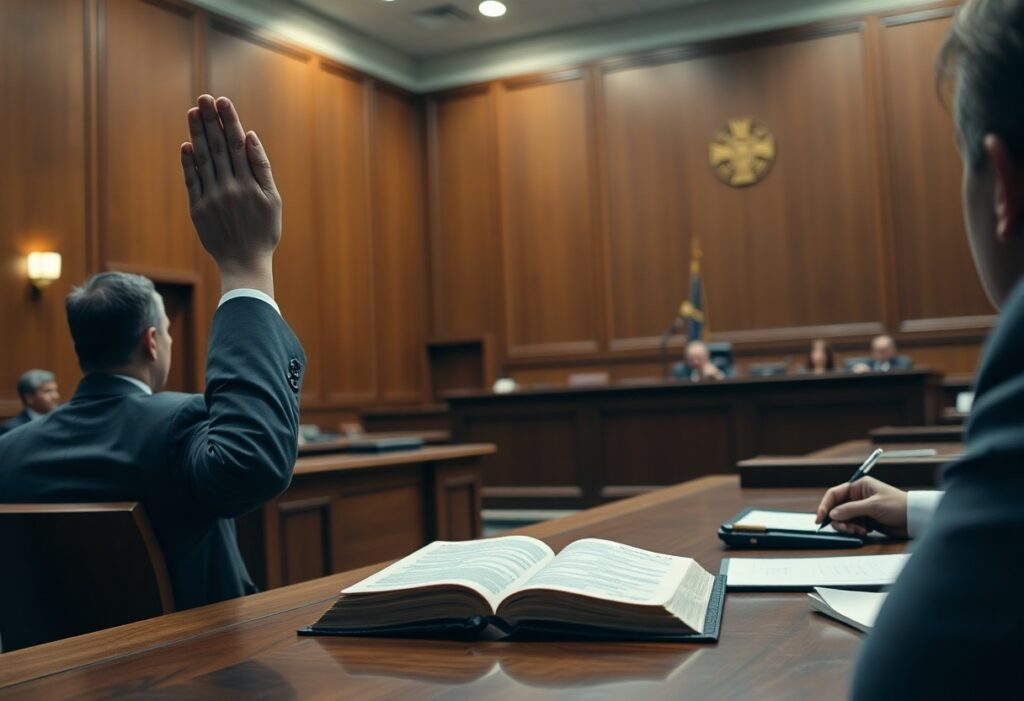

Just one witness’s account can shift the direction of your case. You need to understand how testimony influences credibility, evidence interpretation, and courtroom perception. The statements given by witnesses-whether eyewitnesses, experts, or character references-directly shape how your defense is received. You must assess reliability, consistency, and potential biases early to build the strongest possible strategy.
The Faulty Lens of Memory
Memory isn’t a recording-it’s a reconstruction. Each time you recall an event, your brain reshapes it slightly, influenced by emotion, suggestion, and time. You may believe your recollection is clear, but subtle distortions creep in, often without notice. This natural imperfection can quietly undermine even the most sincere testimony.
Truth shifts like sand in the wind. A man sees what he wants to see when the light is low and the night is long.
Perception bends under uncertainty. In dim light or high tension, your mind fills gaps with assumptions. What you swear you saw may reflect expectation more than reality. Shadows play tricks, and the brain, eager for coherence, creates a story that feels true-even when it isn’t.
Fear clouds the mind and breaks the story. The heart beats fast and the memory fails under the pressure of the moment.
Adrenaline alters awareness. When fear takes hold, your focus narrows-details vanish, time distorts, and events blur. You might recall a weapon clearly but miss the face holding it. This isn’t dishonesty; it’s how the body survives. Yet in court, that fragmented memory becomes fixed testimony.
Under threat, the brain prioritizes survival over precision. Your senses may lock onto a loud noise or sudden movement while ignoring peripheral facts. Later, when asked to recount everything, you can’t retrieve what was never fully processed. This isn’t deception-it’s neuroscience. Recognizing this helps your defense challenge the weight given to eyewitness accounts shaped in moments of panic.

The Sharp Blade of Cross-Examination
You wield cross-examination like a scalpel, not a hammer. Every question is measured, designed to expose inconsistencies others overlook. Your goal isn’t confrontation-it’s control. When you take the stand, you don’t react; you guide. The witness speaks, but you shape the narrative with precision.
Cutting through the false story with precision. You find the holes where the lies leak out until the truth falls away.
Truth often hides in the gaps between words. You press the witness on small details-dates, distances, directions-and watch their story fray. A hesitation here, a contradiction there. Each misstep widens the crack until the entire account collapses under its own weight.
Silence as a weapon in the courtroom. Sometimes the things a witness does not say tell the jury the real story.
Pauses speak louder than answers. When you pose a simple question and the witness freezes, the jury notices. That silence isn’t empty-it’s loaded. You let it linger, refusing to rush in. In that stillness, doubt takes root and grows.
What a witness avoids can be more revealing than what they volunteer. You’ve seen it happen-when a defendant’s name isn’t mentioned, or a key moment goes unexplained. You don’t fill the gap. You highlight it. Jurors begin to wonder why something so obvious was ignored. That silence becomes a footprint leading away from the prosecution’s version of events. You don’t need to shout; you just need to wait.
The Cold Facts of Experts
Data that exists without emotion. The machines and the math do not lie even when the people are confused or bought.
You rely on forensic reports, lab results, and algorithmic reconstructions because they operate beyond bias. When a breathalyzer registers a blood alcohol level or GPS data traces a route, the numbers stand regardless of intent or perception. These outputs don’t waver under cross-examination-they simply are.
The hard weight of physical proof. A jury likes a thing they can see and measure with their own eyes and hands.
Physical evidence lands differently when passed from juror to juror. A bullet casing, a torn jacket, a fingerprint card-these items feel real in a way testimony never can. You know jurors will turn them over in their hands, looking for certainty in what they can touch.
Juries anchor their decisions in objects they can inspect. When you place a weapon on the table or show a timeline built from security footage timestamps, you give them something concrete to return to during deliberations. Unlike memory, which frays, or words, which shift, physical proof remains fixed-and that stability shapes how your entire defense is received.
The Man Who Was Not There
Being wrongly placed at a crime scene can shatter lives, but your absence is just as powerful as presence. When evidence shows you were miles away, it creates doubt the prosecution cannot ignore. Your defense must act fast to prove where you truly were.
Proof of distance and time. If a man is in one town he cannot be in another doing a bad thing.
Distance matters when timing contradicts the state’s story. GPS data, surveillance footage, or timestamped purchases can dismantle false claims. You weren’t there-let the minutes and miles prove it beyond doubt.
Friends who stand and speak the truth. Good men tell the court where you were and the things you actually did.
People who were with you carry weight when they step into court. Their honest words paint a clear picture of your actions that night. A shared meal, a phone call, or a simple hangout becomes your alibi.
These witnesses aren’t just character references-they’re factual anchors. They recall details only someone present would know: the joke you told, the game you watched, the route you drove. Their testimony doesn’t just support your story-it confirms it with lived experience, making it harder for doubt to take root.

A Name Built Over Years
Your reputation isn’t formed overnight-it’s shaped by consistent choices, integrity, and the way others see your character over time. When witness testimony reflects a life of honesty and responsibility, it becomes a powerful part of your defense. Jurors respond to real, credible accounts of who you are, not just what you’re accused of.
The value of a clean and honest record. A life lived well is a hard thing for a prosecutor to tear down.
A history of integrity speaks louder than isolated allegations. Witnesses who confirm your honesty, reliability, and good conduct offer a pattern that contradicts criminal accusations. When people who know you testify to your character, they present a narrative that’s difficult to dismiss.
Facing the fire of the accuser. A good reputation is the shield that stops the arrows shot in the dark of the court.
Accusations thrive in ambiguity, but your reputation stands as a barrier against baseless claims. When witnesses affirm your decency and consistency, they deflect attempts to paint you as guilty. Their words don’t just support your innocence-they protect your identity under attack.
When you’re facing direct allegations, character witnesses become your frontline defense. Their testimony doesn’t just say you’re a good person-it shows the court why that matters. Judges and jurors weigh credibility heavily, and a consistent history of ethical behavior, confirmed by others, forces them to question whether the accusations align with the person you’ve proven to be over time.
The Twelve in the Box
Jurors carry the weight of judgment into the courtroom, and their perceptions shape outcomes. You’re not just presenting facts-you’re speaking to twelve individuals with instincts, biases, and personal histories. How they interpret a witness’s demeanor often matters as much as what is said. Your defense must account for the human element seated in that box.
What they see in a witness face. They watch the eyes and the steady hands of the person telling the tale.
Appearance speaks before words ever do. Jurors study a witness’s face for signs of truth-eyes that meet theirs without flinching, hands that don’t tremble under pressure. A calm presence can lend credibility, while a blink too long or a twitching finger might plant suspicion. You know every gesture is being measured, even if unconsciously.
The birth of a reasonable doubt. It only takes one small crack in the story for the light of freedom to come in.
Doubt doesn’t need a landslide-just a whisper. One inconsistency, one pause too long, one detail that doesn’t align. That’s all it takes for a juror to question the entire narrative. You’re not proving innocence outright; you’re creating space where uncertainty can grow.
Even the most polished testimony can unravel under scrutiny. When a witness hesitates on a timeline or contradicts a prior statement, that moment becomes your opening. Jurors don’t demand perfection, but they notice when a story bends under pressure. Your job is to highlight those moments without overreaching-let the doubt take root on its own.
To wrap up
To wrap up, witness testimony directly shapes your defense strategy by influencing credibility, timeline accuracy, and case perception. You control how witnesses are prepared and presented, making their accounts a powerful tool in challenging the prosecution’s narrative. Your choices in handling testimony can shift the outcome, so precision and consistency are key.