
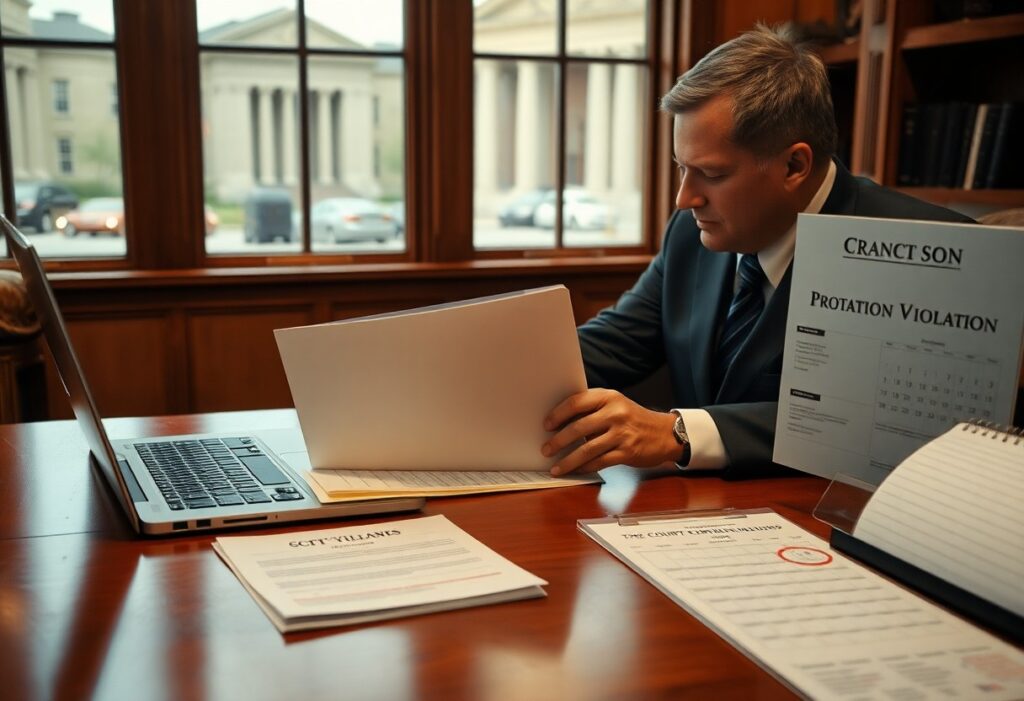
You should expect your lawyer to immediately review the violation report, consult probation officers, gather and challenge evidence, file necessary motions, request hearings, negotiate alternatives to revocation, and argue for reduced penalties or reinstated supervision.
Initial Case Assessment and Evidence Review
Your lawyer reviews case files, police reports, prior probation paperwork, and witness statements to assess evidentiary strength and possible defenses, forming an initial strategy for hearings and negotiations.
Analyzing the Formal Violation Report
Carefully examine the violation report’s allegations, timelines, and sources to spot inconsistencies, missing evidence, or procedural defects that you can challenge at the hearing.
Identifying the Specific Terms of Probation Allegedly Breached
You identify the precise probation conditions alleged to be breached, such as curfews, travel limits, drug testing, mandatory programs, or no-contact orders, and note the required proof standard.
Examine each condition’s exact language, dates, and any court-ordered amendments so you can assess ambiguity, notice, or impossibility of compliance; collect probation officer reports, logs, testing records, and supporting documentation from employers or treatment providers to rebut allegations or show partial compliance, and plan targeted defenses or mitigation aimed at reducing sanctions.
Strategic Client Consultation and Fact-Finding
Client consultations let you provide a full account, disclose probation terms, and map immediate defenses while the lawyer verifies records and deadlines.
Gathering Client Testimony and Alibi Documentation
Collecting your testimony and alibi documents helps the lawyer craft a timeline, identify inconsistencies, and assemble evidence that supports absence or lawful conduct during the alleged violation.
Interviewing Potential Witnesses and Character References
Approach potential witnesses to secure statements and character references that reinforce your version of events, allowing counsel to evaluate credibility and trial viability.
When you identify witnesses, prioritize those with direct observations, obtain signed statements, preserve contact details, and rehearse questions so testimony aligns with documentary evidence and probation terms; counsel will flag inconsistencies early.

Distinguishing the Nature of the Violation
You determine whether the violation is technical or involves new criminal conduct, since that distinction shapes hearing procedures, burdens of proof, and potential penalties.
Addressing Technical Violations vs. New Criminal Charges
When the infraction is purely technical, you prioritize compliance documentation and plea alternatives; if new charges exist, you prepare investigative discovery and contest probable cause for arrest and charging decisions.
Identifying Mitigating Circumstances and Procedural Errors
Assess whether circumstances like medical emergencies, treatment participation, or law enforcement mistakes can reduce sanctions or support dismissal, and locate procedural defects in arrest or notice.
Document timelines, collect medical and treatment records, obtain witness statements, and secure proof of compliance so you can show mitigating context. Challenge search or arrest procedures by filing suppression motions, pointing out missing or defective notices, improper service, or broken chain of custody, and explain how those errors prejudice your case and support reduced sanctions or dismissal.
Pre-Hearing Negotiations with the Prosecution
You will see your lawyer open directed negotiations with the prosecutor, presenting compliance history, mitigating facts, and legal arguments to limit sanctions or secure alternatives before a hearing.
Proposing Alternative Sanctions and Remedial Measures
Your attorney may propose community service, counseling, restitution, electronic monitoring, or tailored treatment plans to address violations while keeping you out of custody.
Seeking Case Dismissal or Probation Reinstatement
If evidence is weak or procedures were faulty, your lawyer files motions and argues for dismissal or probation reinstatement based on legal defects and demonstrated rehabilitation.
Documentation you collect-treatment records, employment verification, witness statements, and probation officer reports-enables counsel to show compliance, challenge allegations, expose procedural errors, and persuade the court that dismissal or reinstatement serves justice.

Defense Representation at the Revocation Hearing
Your lawyer asserts procedural protections, contests the alleged violations, presents mitigating evidence, and argues for alternatives to incarceration to keep revocation from being automatic.
Challenging the Prosecution’s Burden of Proof
You force the state to meet its burden by demanding proof beyond speculation, objecting to unreliable hearsay, and highlighting gaps that prevent a finding of violation.
Cross-Examining the Probation Officer and State Witnesses
When cross-examining the probation officer and state witnesses, you probe inconsistencies, question timing and observation methods, and expose training or memory limits to weaken their testimony.
Ask pointed questions about where and when an alleged violation occurred, who else was present, how observations were recorded, whether surveillance or physical evidence exists, and any prior contradictory statements; use records, timestamps, and documentary proof to pin down inconsistencies and undermine witness reliability.
Advocating for Favorable Sentencing Outcomes
You press for alternatives to incarceration by compiling mitigation, treatment plans, community supports, and legal arguments that persuade the judge to impose modified probation or treatment-focused sentences.
Presenting Evidence of Rehabilitation and Compliance
Your lawyer gathers employment records, treatment certificates, progress reports, and witness statements to document sustained compliance and present a credible picture of rehabilitation.
Arguing Against Incarceration in Favor of Continued Supervision
Ask the court to continue supervision, stressing your stable housing, treatment plans, supportive contacts, and proposed monitoring that reduce risk while avoiding imprisonment.
Provide a detailed supervision proposal showing specific conditions, treatment schedules, electronic monitoring options, and graduated sanctions; have probation officers, treatment providers, and experts testify to feasibility, while your counsel cites statutes and precedents that favor community supervision over incarceration.
Final Words
Taking this into account, you contact your lawyer promptly, share all details, permit them to file responsive motions, pursue modifications or treatment alternatives, prepare evidence and witnesses, and let them argue mitigation at the hearing to limit sanctions.