

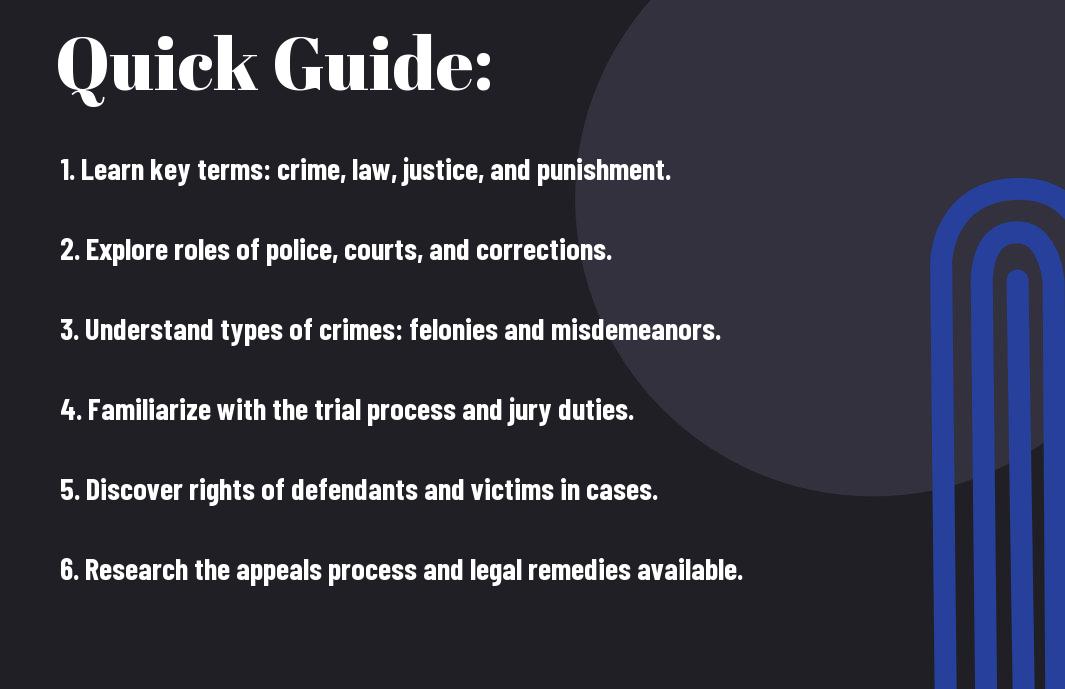
Just as you launch on your journey to understand the criminal justice system, you’ll encounter key concepts that shape its framework. This guide is designed to break down the complexities of the system, providing you with clear explanations of pivotal terms and processes. Whether you’re a student, a concerned citizen, or simply curious, this comprehensive overview will empower you to grasp how justice is served and the roles of various entities within the system. You’ll find fundamental principles that will enhance your knowledge and foster informed discussions surrounding justice issues.

The Foundation of Criminal Justice
While the criminal justice system may seem complex, it is built on a foundation of key principles and structures that guide its operation. These fundamental aspects ensure that justice is served fairly while maintaining public safety. Understanding the foundation of criminal justice helps you grasp how laws are enforced, rights are protected, and social order is maintained.
Types of Legal Systems Around the World
While exploring global justice systems, you’ll notice different legal frameworks at play. Here are some common types:
- Common Law – Based on judicial decisions and precedents.
- Civil Law – Primarily based on codified statutes.
- Religious Law – Rooted in religious texts and beliefs.
- Customary Law – Based on societal norms and traditions.
- Hybrid Systems – Combines elements from different legal systems.
Knowing these types provides insight into how justice is approached in various cultures.
| Type of Legal System | Characteristics |
| Common Law | Judgments based on precedent |
| Civil Law | Strict adherence to written codes |
| Religious Law | Guided by spiritual doctrines |
| Customary Law | Derived from long-standing traditions |
Core Principles and Values in Criminal Justice
Clearly, the criminal justice system is underpinned by several core principles that foster fairness, accountability, and respect for human rights. These principles are designed to guide the actions of law enforcement, the judiciary, and correctional institutions, ensuring that each individual’s rights are upheld while maintaining societal order.
The core principles of criminal justice include fairness, justice, equality, accountability, and proportionality. These values serve as crucial guiding tenets in your interactions with the system, helping you navigate the complexities of law enforcement and judicial proceedings. Understanding these principles empowers you to advocate not only for your rights but for the integrity of the entire justice system. By embracing these foundational values, you contribute to a more just society, ensuring that justice is accessible to all individuals. Ultimately, these principles are vital in promoting trust between communities and the justice system.
Key Components of the Criminal Justice System
One of the most significant aspects of the criminal justice system includes three key components: law enforcement, courts, and corrections. Each component plays a vital role in ensuring justice is served, balancing the need for public safety with the rights of individuals. Understanding these components is necessary for grasping how the system works together to maintain order and fairness. By familiarizing yourself with each of these elements, you will gain a deeper insight into the processes that govern criminal justice.
Law Enforcement: First Point of Contact
System officers are often the first point of contact you will have with the criminal justice system. They are responsible for enforcing laws, responding to emergencies, and investigating crimes. Law enforcement agencies work tirelessly to protect the public and maintain peace, often acting as the gatekeepers to the judicial process. Your understanding of their role can provide valuable context as you navigate through your interactions with the justice system.
Courts: The Adjudication Process
On entering the courtroom, the judicial system takes over, interpreting the law and evaluating evidence to determine guilt or innocence. Courts serve as the platform where cases are heard, and justice is dispensed through trials, pleas, and sentencing. The court’s role in the adjudication process is pivotal—it ensures that proceedings are conducted fairly while respecting the rights of all parties involved, including victims and defendants.
This process begins with the arraignment, where charges are formally presented, followed by various hearings and potentially a trial. During the trial, evidence is presented, witnesses testify, and legal arguments are made before a judge or jury. The outcome can lead to varying results, including acquittals, convictions, or plea deals, each impacting your understanding of legal consequences and rights.
Corrections: Punishment and Rehabilitation
Punishment and rehabilitation are integral to corrections, which manage individuals convicted of crimes. This component aims to provide fair consequences for criminal activities while also offering opportunities for reform and reintegration into society. Understanding how corrections function can illuminate the balance between holding individuals accountable and fostering their rehabilitation.
Plus, rehabilitative programs, such as counseling, education, and vocational training, are necessary to reducing recidivism and assisting offenders in reintegrating into society. By focusing on rehabilitation, the corrections system recognizes that many individuals can change their behaviors with the right support and resources. Exploring these facets of corrections will deepen your comprehension of how the criminal justice system as a whole strives for public safety and improved lives.
Step-by-Step Journey Through the Criminal Justice Process
For anyone new to the criminal justice system, understanding the various stages can be overwhelming. Below is a simple breakdown of the process, allowing you to follow along as cases develop from initial encounters with law enforcement to final resolutions.
| Stage | Description |
|---|---|
| Arrest | The police detain a suspect based on evidence or probable cause. |
| Booking | Documentation occurs, including fingerprinting and photographing. |
| Pre-Trial | Court proceedings to set bail and schedule the trial. |
| Trial | The case is presented before a judge or jury. |
| Sentencing | If found guilty, the judge imposes a penalty. |
From Arrest to Booking
Clearly, the journey begins with an arrest, where you or someone you know is detained by law enforcement. Post-arrest, the booking process takes place, which involves entering personal information into the system, taking fingerprints, and capturing a mugshot. This process establishes a record of the encounter and sets the stage for what follows in the criminal justice proceedings.
Pre-Trial Procedures and Bail
StepbyStep, after the booking process, you enter the pre-trial phase. This stage often includes bail hearings where the court determines whether you can be released and under what conditions. It’s critical to grasp how these decisions can impact your situation and the course of the legal process ahead.
Plus, the pre-trial procedures may involve negotiations, plea deals, and pre-trial motions to determine the admissibility of evidence. These elements can significantly influence the trajectory of your case, often leading to an agreement that might avoid the trial altogether. Understanding these procedures can provide you with better insights into potential outcomes and your rights during this stage.
Trial Process and Sentencing
Trial, in the next phase, you will experience a more formal setting where evidence is presented in front of a judge or jury. This is your opportunity to contest the charges and assert your defense, which can lead to either a verdict of guilty or not guilty.
The trial process and sentencing are pivotal moments that can reshape your future. If found guilty, the judge will determine the appropriate penalties based on various factors, such as the severity of the crime and any mitigating circumstances. Understanding how this phase works can prepare you for the realities of possible outcomes and the implications of a conviction.
Understanding Criminal Law Basics
To navigate the criminal justice system effectively, it’s crucial to grasp the fundamentals of criminal law. This area of law governs behaviors deemed unacceptable and establishes the penalties for those offenses. By understanding these basic principles, you can comprehend how the justice system addresses crime and the nuances involved in enforcement and prosecution.
Types of Crimes and Classifications
To gain a better understanding of criminal law, you should familiarize yourself with the various types of crimes and their classifications:
- Felonies
- Misdemeanors
- Infractions
- White-collar crimes
- Violent crimes
Knowing each type of crime is crucial for understanding the legal landscape and the potential penalties involved.
| Type of Crime | Classification |
| Robbery | Felony |
| Theft | Misdemeanor |
| Traffic violations | Infraction |
| Fraud | White-collar crime |
| Assault | Violent crime |
Elements of a Crime Explained
Classifications of a crime can be broken down into specific elements that must be present for an action to be legally defined as a crime. These elements often include a criminal act (actus reus), a person’s mental state (mens rea), and causation. It’s important to understand each component, as they can significantly affect the outcome of a case.
Another important aspect to consider is how these elements interact in various legal scenarios. For instance, having a guilty mind (mens rea) is fundamental in differentiating between voluntary and involuntary actions. Each element plays a vital role in defining the crime’s severity and determining appropriate punishment. A thorough understanding of these components will empower you to analyze legal cases more effectively and may even influence your perspective on law enforcement and justice.
Rights of the Accused
Unlike many aspects of society, the criminal justice system places a strong emphasis on protecting the rights of individuals accused of a crime. These rights are fundamental for ensuring a fair trial and preventing wrongful convictions. Understanding these protections allows you to navigate the legal landscape more effectively, whether you’re involved directly or simply observing the system at work.
Constitutional Protections
Constitutional protections are vital rights enshrined in the U.S. Constitution that safeguard individuals accused of crimes. These protections include the right to a fair trial, protection against self-incrimination, and the guarantee of due process. Knowing your constitutional rights not only empowers you but also ensures that justice is upheld.
The Right to Legal Representation
Any accused person has the right to legal representation, which is necessary for ensuring fairness in legal proceedings. This right guarantees that you can have a qualified attorney advocate on your behalf, helping to navigate complex legal issues and presenting your case effectively in court.
Another important aspect of the right to legal representation is that it ensures you receive guidance throughout all stages of the criminal process. An experienced attorney can help you understand the charges against you, explore plea options, and prepare a strong defense. Without adequate legal support, you may struggle to understand your options and suffer from the overwhelming complexities of the system. Thus, having proper representation significantly enhances your chances for a favorable outcome.

Factors Affecting Criminal Justice Outcomes
Many elements shape the criminal justice outcomes you may encounter. Understanding these factors is vital for grasping the system’s complexities. Key contributors include:
- Law enforcement practices
- Judicial discretion
- Socioeconomic status
- Public perception
The interplay of these factors impacts how cases are resolved and the consequences for individuals involved.
Socioeconomic Factors and Disparities
If you examine the criminal justice system, you will find that socioeconomic factors play a significant role in shaping outcomes. These disparities manifest in various ways:
- Access to legal representation
- Quality of defense services
- Sentencing patterns
- Community resources
Recognizing the influence of socioeconomic status can help you better understand the systemic challenges faced by different groups.
The Role of Discretion in Decision-Making
Little do many realize that discretion is a double-edged sword within the criminal justice system. Law enforcement officers, judges, and attorneys often have the authority to make choices that significantly impact outcomes. Your interaction with the system may vary based on how these individuals exercise their discretion, thereby influencing arrests, charges, and sentencing.
Understanding the role of discretion in decision-making is imperative for grasping the nuances of the criminal justice system. Discretion allows authorities to make context-sensitive judgments, but it can also lead to inconsistencies and potential biases. Your experiences can differ widely based on variables such as the officer’s judgment, the judge’s perspective, or the prosecutor’s priorities. This element underscores the importance of accountability and transparency in the decision-making process, affecting you and those around you.

Pros and Cons of Current Criminal Justice Approaches
Not all criminal justice approaches are without their advantages and drawbacks. Each method carries implications that affect not only offenders but also the community at large. Understanding these pros and cons can help you navigate the complex landscape of the justice system. Below is a breakdown of the advantages and disadvantages of current approaches:
| Pros | Cons |
|---|---|
| Deterrence of crime | Possibly ineffective for certain individuals |
| Accountability for actions | May perpetuate cycles of recidivism |
| Maintenance of social order | Disproportionate impact on minority communities |
| Victim restitution | High costs of incarceration |
| Rehabilitation efforts | Limited resources and support |
| Reduction of future crimes | Overcrowding in prisons |
| Structured reintegration | Public mistrust of the system |
| Potential for restorative justice | Inconsistency in application |
| Focus on behavioral correction | Risk of stigmatization |
| Adaptability to new evidence | Resistance to change from traditional models |
Traditional Punishment vs. Rehabilitation Models
Pros of traditional punishment models include immediate consequences for criminal behavior, which may deter potential offenders. Conversely, rehabilitation models aim to address underlying issues such as mental health or substance abuse, promoting reintegration into society. Understanding the balance between these approaches can enhance your perspective on justice.
Reform Movements and Alternative Justice Methods
Punishment is a method often criticized for its lack of focus on recovery and reform. Alternatives have emerged, advocating for community-based solutions, restorative justice practices, and mental health interventions. These methods seek to prioritize healing and rehabilitation over mere confinement.
Another key aspect of reform movements is their emphasis on restorative justice, which seeks to repair harm rather than solely punish offenders. This approach encourages dialogue between victims and offenders, fostering accountability while providing necessary support for rehabilitation. Moreover, alternative justice methods, such as community service or diversion programs, may reduce the jail population while better addressing the root causes of criminal behavior. Engaging with these models can enhance not only your understanding of justice but also contribute to a more effective and humane system overall.
Summing up
To wrap up, understanding the criminal justice system is imperative for you as it empowers you to navigate its complexities. By familiarizing yourself with key concepts such as law enforcement, the court process, and corrections, you can gain a clearer perspective on how justice operates in your community. This foundational knowledge not only enhances your awareness of your rights but also informs your understanding of societal issues related to crime and punishment. Equip yourself with this understanding to engage thoughtfully with the world around you.