

It’s vital to understand double jeopardy laws, as they play a significant role in the legal system. These laws protect you from being tried more than once for the same offense, thereby safeguarding your rights and ensuring that legal procedures are fair. In this post, you’ll learn about the origins of double jeopardy, the circumstances under which it applies, and the exceptions that may allow for retrials. Armed with this knowledge, you can better navigate the complexities of criminal law and understand its implications for yourself or someone you know.
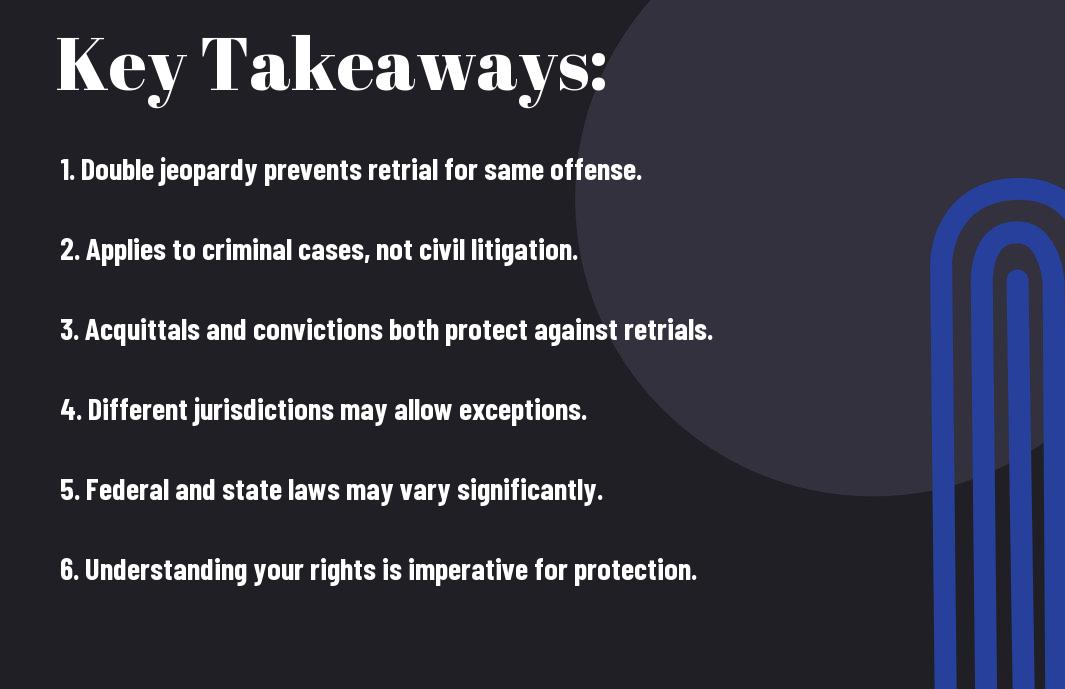
Historical Background of Double Jeopardy
A fundamental principle in criminal law, double jeopardy protects individuals from being tried more than once for the same crime. Originating from ancient practices, this legal doctrine has evolved over centuries to establish a key safeguard in the judicial system. Understanding its historical context helps you appreciate the importance of this protection in modern law.
Origins in Common Law
On examining the roots of double jeopardy, you find that it originated in English common law, where it was established as a means to prevent governmental abuse and protect defendants from facing multiple punishments for the same offense. This principle has been integral in shaping modern legal systems around the world.
Constitutional Protection in the Fifth Amendment
Against the backdrop of American law, the Fifth Amendment provides an crucial safeguard against double jeopardy, ensuring that you cannot be tried again for a crime after a legitimate acquittal or conviction. This constitutional protection reflects the Founding Fathers’ commitment to justice and fairness in the legal process.
Considering the implications of the Fifth Amendment, you gain insight into how this protection impacts your legal rights. If you are acquitted or convicted, the law limits the circumstances under which a government entity can pursue a second trial for the same offense. Understanding these legal boundaries can empower you when navigating the complexities of the justice system.

Core Elements of Double Jeopardy Protection
One of the primary aspects of double jeopardy protection is its ability to shield you from being tried for the same crime more than once. This legal principle ensures that once you have been acquitted or convicted, the prosecution cannot bring you to trial again for that specific charge. Understanding this shield is pivotal in safeguarding your right to a fair judicial process.
Same Offense Requirement
The same offense requirement signifies that you cannot be retried for the same crime after a verdict has been reached. This means that if you are acquitted or convicted for a specific act, no subsequent trial can occur for that same act, regardless of any new evidence that may surface later.
Attachment of Jeopardy
By understanding the concept of attachment of jeopardy, you will grasp when your protections under double jeopardy activate. This occurs when a judge formally accepts a trial jury, making you legally at risk of being convicted or acquitted—marking the point where double jeopardy protections truly begin.
Due to the attachment of jeopardy, your legal protections are firmly established at the commencement of your trial. Once jeopardy has attached, any further prosecution for the same offense is barred, emphasizing the integrity of the judicial process. This attachment helps to promote finality in criminal cases, ensuring that you do not face the anxiety or burden of repeated trials for the same alleged crime.
Exceptions to Double Jeopardy
For many, the concept of double jeopardy offers protection against being tried for the same crime twice. However, there are notable exceptions that can subject you to additional trials under certain circumstances, ensuring that justice is served even when it may appear that double jeopardy applies. Understanding these exceptions is crucial when navigating the legal landscape.
Dual Sovereignty Doctrine
Against the backdrop of federalism, the dual sovereignty doctrine allows different sovereign entities—such as state and federal governments—to prosecute you for the same act without violating double jeopardy protections. This means if you are acquitted or convicted in one jurisdiction, the other can still proceed with its case, resulting in potentially facing trials from both a state and a federal level.
Mistrials and Hung Juries
About legal proceedings, mistrials and hung juries present another exception to double jeopardy. If a trial ends prematurely due to a serious error, jury deadlock, or other considerable issues, you can be retried for the same charge without violating double jeopardy laws.
Mistrials may occur for various reasons, such as improper evidence, juror misconduct, or procedural errors. When a jury cannot reach a unanimous decision, it results in a hung jury. In either case, the original trial is considered void, enabling prosecutors to retry you without any double jeopardy implications. Your legal rights in these situations are significant as they allow for justice to be pursued even when the initial trial does not yield a decisive outcome.

Double Jeopardy Across Jurisdictions
Once again, it’s vital to understand that double jeopardy laws vary significantly across jurisdictions. In the United States, the Constitution protects you against being tried twice for the same crime in the same legal system. However, state and federal courts operate independently, which means you could face separate charges for the same act under different jurisdictions. Internationally, you may also encounter different laws affecting how double jeopardy is applied, making it vital to be aware of the legal landscape beyond your own country’s borders.
State vs. Federal Prosecutions
Behind the scenes of double jeopardy laws, the distinction between state and federal prosecutions plays a vital role. If you are tried and acquitted in a state court, it does not automatically shelter you from being charged at the federal level for the same actions. This layered legal system can lead to complex situations where your rights may differ depending on the jurisdiction pursuing the case.
International Double Jeopardy Considerations
Jeopardy becomes even more complex when you consider international laws. Different countries have varied interpretations of double jeopardy, with some allowing retrials under specific conditions. If you find yourself facing charges in multiple nations, understanding how each country’s system handles double jeopardy is vital for your defense and legal strategy.
Indeed, international double jeopardy considerations can be quite complex. Some countries abide by similar principles to the U.S., preventing retrials for the same offense, while others have exceptions that may permit it. Additionally, extradition treaties can influence whether you face prosecution in different jurisdictions, particularly if the offenses are related. Being aware of these differences can significantly impact your legal strategy and potential outcomes in a global context, so staying informed is paramount.
Notable Supreme Court Cases
Not every case regarding double jeopardy is straightforward, and several notable Supreme Court cases have helped define its limits and applications. Each decision contributes significantly to your understanding of double jeopardy and its implications in the legal system.
Gamble v. United States (2019)
An important case in the context of double jeopardy, Gamble v. United States reaffirmed the dual sovereignty doctrine. This doctrine allows both federal and state governments to prosecute for the same offense without violating double jeopardy protections, meaning you can be tried both at the state and federal level for the same crime.
Blockburger v. United States (1932)
Below the surface of double jeopardy laws lies the Blockburger test, which emerged from Blockburger v. United States. This test determines whether two offenses are the same for the purposes of double jeopardy, focusing on whether each charge requires proof of a fact that the other does not.
States have taken the Blockburger test to heart, using it to evaluate whether separate legal charges arise from the same act. This means that if each offense has distinct elements that require different proofs, the defendant can be tried separately for both. Thus, you may face multiple charges stemming from a single incident if the crimes do not overlap in their legal elements, providing greater clarity on the boundaries of double jeopardy protections.

Practical Implications for Defendants
Keep in mind that the double jeopardy law can significantly impact your case. If you are acquitted of a crime, the law protects you from being tried for the same offense again, ensuring that you can move forward without the shadow of re-prosecution hanging over you. However, the nuances of this law can also affect plea deals and the overall strategy of your defense, so understanding its implications is vital to your legal journey.
Strategic Considerations
Below are several strategic considerations you should be aware of when navigating the double jeopardy landscape. Understanding when and how this protection applies can influence your choices, from whether to accept a plea deal to how to approach potential appeals. Evaluating your case’s specific circumstances will allow you to make informed decisions about your legal strategy moving forward.
Working with Legal Counsel
Among the most necessary steps you can take is to work closely with experienced legal counsel. Your attorney will help you understand the complexities of double jeopardy and how it relates to your unique situation, ensuring that your rights are fully protected throughout the legal process.
Counsel will guide you through the orientation of your case in relation to double jeopardy laws. They will explain how prior verdicts or acquittals impact your current legal standing and advise you on the best strategic course of action. By discussing your options openly, you can navigate potential legal challenges and make empowered decisions about how to address your circumstances in court.
Final Words
On the whole, understanding double jeopardy laws is crucial for your awareness of the legal system. These laws protect you from being tried more than once for the same offense, ensuring fairness in the judicial process. However, exceptions exist that you need to be aware of, such as separate charges or jurisdictions. Familiarizing yourself with these nuances can save you from potential legal pitfalls and empower you to make informed decisions should you ever face criminal charges.